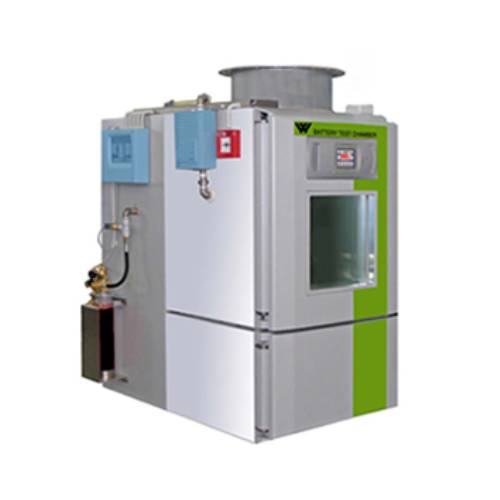
Lithium Ion Battery Test Chamber
Explore Lithium Ion Battery Test Chamber models, product information, configurations and available options.
Price on request
Configured to your requirement · Quote in 24 h

Browse the individual Battery Test Chamber models available in the legacy ACMAS product range.
Explore Lithium Ion Battery Test Chamber models, product information, configurations and available options.
A Battery Test Chamber is specialized testing equipment used to evaluate battery performance, reliability, and stability under controlled environmental conditions. It helps manufacturers and testing laboratories assess how batteries respond to different temperatures and, depending on the equipment configuration, humidity and other environmental factors. ACMAS Technologies offers laboratory and environmental testing equipment solutions to support product evaluation, quality assurance, and research and development across industrial applications.
With the growing use of lithium-ion batteries, rechargeable batteries, and energy storage systems, controlled testing has become increasingly important for evaluating battery behavior under defined operating and storage conditions. A Battery Test Chamber can help identify temperature-related performance changes, assess environmental durability, and support battery qualification procedures. Selecting the appropriate chamber according to battery dimensions, required temperature range, test profile, and safety requirements is essential for reliable testing.
A Battery Test Chamber is an environmental testing enclosure designed to expose batteries and battery-related components to specified temperature conditions and, where supported, controlled humidity conditions. It helps laboratories evaluate battery behavior during environmental exposure and determine whether products meet defined performance and quality criteria.
Battery testing may involve individual cells, battery modules, packs, or related components, depending on the chamber's capacity and intended application. These tests can support research and development, manufacturing quality control, product verification, and environmental qualification.
The required chamber design depends on the battery chemistry, energy capacity, test procedure, and potential hazards associated with the specimen. Battery electrical cycling, charging, and discharging may require a separate battery cycler or an integrated testing system compatible with the chamber.
A Battery Test Chamber works by establishing and maintaining defined environmental conditions around the battery or specimen being tested. A control system manages the chamber's heating and cooling functions to achieve the selected temperature profile.
The general testing process includes:
Charging, discharging, electrical measurement, and real-time battery monitoring require suitable compatible equipment and must not be assumed to be included in every environmental chamber.
When selecting a Battery Test Chamber, manufacturers should evaluate the features required for their specific battery testing applications.
Available features and safety provisions must be confirmed against the actual equipment specifications and the intended battery application.
Battery Test Chambers support environmental testing and product development in a variety of sectors.
The chamber size, safety design, and test configuration should match the specimen's electrical characteristics and the intended test procedure.
Battery testing includes several methods, and the appropriate equipment depends on the objective of each test.
Environmental chambers do not automatically perform every electrical, mechanical, abuse, or safety test. Required procedures and applicable standards should be identified before equipment selection.
A suitable Battery Test Chamber helps organizations establish controlled environmental conditions for battery evaluation and product development.
Actual results depend on battery chemistry, test parameters, measurement methods, and the acceptance criteria established for the application.
Choosing a Battery Test Chamber requires careful evaluation of the battery type, testing objectives, and safety risks.
Battery testing can involve fire, toxic gas, and thermal runaway hazards. The equipment must be specifically assessed for the intended battery chemistry, stored energy, fault conditions, and testing procedure. A general-purpose temperature chamber should not be assumed suitable for hazardous battery testing.
ACMAS Technologies provides laboratory and environmental testing equipment solutions for industrial and research applications. Its testing equipment range supports different product evaluation requirements, and a suitable battery testing configuration should be selected according to the intended application.
Before purchasing a Battery Test Chamber, customers should confirm the required temperature range, battery dimensions, electrical testing needs, monitoring functions, and safety provisions. Discussing these requirements with the supplier helps determine whether the proposed equipment is appropriate for the intended test program.
Explore the test chamber range from ACMAS Technologies and contact the team to discuss your battery testing requirements.
Looking for a Battery Test Chamber for battery development, environmental evaluation, or industrial quality testing? Contact ACMAS Technologies to discuss your battery type, temperature requirements, specimen capacity, electrical testing arrangements, and safety needs.
Request product details and a quotation to identify an appropriate testing solution for your laboratory or manufacturing facility.