
Reach-In Altitude Test Chamber
Explore Reach-In Altitude Test Chamber models, product information, configurations and available options.
Price on
requestConfigured to your requirement · Quote in 24 h

ACMAS Technologies manufactures reach-in and walk-in altitude test chambers in India for evaluating products under reduced atmospheric pressure. Choose a configuration for low-pressure testing or combined temperature and altitude simulation. Compare the two chamber types below to find a fit for your sample size, target pressure and test procedure.
Explore Reach-In Altitude Test Chamber models, product information, configurations and available options.
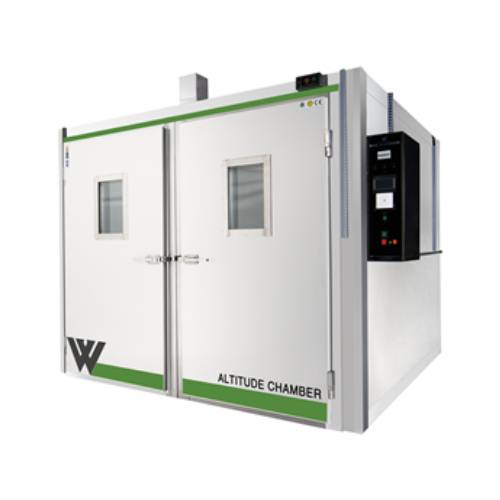
Explore Walk-In Altitude Test Chamber models, product information, configurations and available options.
| Feature | Reach-In Altitude Test Chamber | Walk-In Altitude Test Chamber |
|---|---|---|
| Best suited for | Individual components, sensors and small assemblies | Larger assemblies and test setups that require more workspace |
| Internal workspace | Confirm internal dimensions and usable volume for the selected model | Confirm internal dimensions, usable volume and door opening for your setup |
| Pressure and altitude | Confirm the minimum absolute pressure and equivalent altitude for the selected model | Confirm the minimum absolute pressure and equivalent altitude for the selected configuration |
| Temperature control | Confirm the available temperature range at your target pressure | Confirm the available temperature range at your target pressure and test load |
| Test cycle and options | Check pressure change rate, hold time, data logging and access port requirements | Check pressure change rate, hold time, data logging and any humidity or decompression requirements |
Share your sample dimensions, target pressure and temperature range. ACMAS can help you select a chamber configuration for your test.
An altitude test chamber uses a vacuum system to lower the air pressure inside a sealed enclosure. Pressure sensors monitor the chamber as it reaches and holds the target pressure for the specified test duration. In a temperature-controlled configuration, the chamber also follows the required temperature profile. At the end of the test, the chamber returns to ambient pressure before the sample is removed.
These chambers are commonly used for:
The primary objective is to verify that products maintain their functional performance, structural integrity and operational reliability under low-pressure environmental conditions.
Altitude Chambers work by controlling the atmospheric pressure inside a sealed testing enclosure. A vacuum pump or pressure control system removes air from the chamber to reduce internal pressure and simulate high-altitude conditions.
The operation generally involves the following steps:
This controlled process helps manufacturers understand how their products behave under simulated high-altitude conditions.
An Altitude Test Chamber is used to evaluate product performance under reduced atmospheric pressure. It helps identify problems such as structural deformation, leakage, insulation failure, overheating and functional abnormalities.
Major uses include:
An Altitude Test Chamber provides several benefits to industries that require reliable product performance under low atmospheric pressure conditions. It helps manufacturers improve product quality, identify potential failures and verify equipment reliability before final approval.
The aerospace industry requires equipment and components capable of operating reliably under changing atmospheric pressure and temperature conditions. During aircraft operation, equipment may experience significant pressure variations depending on flight altitude, cabin conditions and aircraft design.
An Altitude Test Chamber helps aerospace manufacturers and testing laboratories simulate these conditions to evaluate the performance and reliability of aircraft components.
Major aerospace applications include:
By conducting altitude testing, aerospace manufacturers can identify potential weaknesses and improve the reliability of equipment designed for demanding flight environments.
Chamber selection depends on the test standard, procedure and operating conditions. Share the standard and revision, target pressure, temperature profile and pressure change rate so ACMAS can confirm the appropriate configuration.
Some important standards associated with altitude and low-pressure testing include:
The applicable standard depends on the product type, intended operating environment, testing objective and customer specifications. The chamber configuration and test procedure should be selected to meet the requirements of the relevant standard.
An Altitude Temperature Test Chamber operates by combining low-pressure simulation with controlled temperature regulation inside a sealed testing enclosure. It is designed to reproduce environmental conditions similar to those experienced by products at high altitudes, where atmospheric pressure and temperature can vary significantly.
The system integrates a vacuum generation mechanism, refrigeration unit, heating elements, temperature sensors and a digital control system to maintain the required testing conditions.
Its working principle involves the following processes:
The product or component is placed inside the chamber according to the required testing configuration.
The operator sets the required altitude equivalent, pressure level, temperature range, testing duration and environmental cycle through the digital controller.
The vacuum pump removes air from the sealed chamber to reduce internal pressure and simulate the selected high-altitude environment.
The heating and refrigeration systems operate according to the programmed temperature profile. They maintain the required high or low temperature conditions during the pressure test.
Pressure sensors and temperature sensors continuously monitor the internal conditions. The control system automatically adjusts the operating components to maintain the programmed parameters.
The test sample is evaluated under the specified combination of temperature and low atmospheric pressure. Its functional performance, structural condition and environmental resistance are assessed.
After the testing cycle is completed, the chamber pressure and temperature are returned to safe removal conditions before the sample is taken out for inspection.
An Altitude Temperature Test Chamber is particularly useful for aerospace, defence, electronics and automotive applications where products must withstand combined temperature and pressure variations.
Send us your sample dimensions, target pressure or equivalent altitude, temperature range and applicable test standard. We can help you select a reach-in or walk-in configuration and prepare a quotation for your application.
Our team can assist you in selecting suitable testing solutions based on your application, technical specifications and testing requirements. Contact ACMAS Technologies to discuss your requirements and get expert assistance.
Get in touch with ACMAS Technologies today for product information, technical consultation and a customized quotation.
Get a Free Quote | Contact Our Experts | Request a Consultation